
Immigration · Innovation · American Growth

Movers & Shapers

One hundred immigrants and first-generation Americans whose work materially expanded U.S. wealth, productivity, technology, health, culture, and global influence — organized by the industries they helped build. They arrived from every continent, in every era, speaking dozens of languages. What they shared was the ambition to make something in America that had not existed before.

Next to the fugitives whom Moses led out of Egypt, the little shipload of outcasts who landed at Plymouth are destined to influence the future of the world.
— James Russell Lowell, American poet and diplomat (1819–1891)

Browse by Industry

Select a category to jump to that section, or scroll to explore all one hundred profiles. Each section covers the immigrants whose contributions most shaped that field of American life.

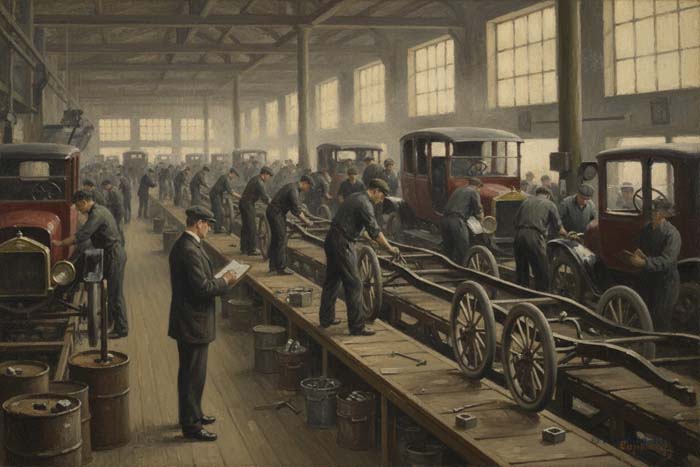
Workers and machinery on an early American automobile assembly line

Industry, Manufacturing, Transportation & Communications

The builders of American industrial capacity — steel, power, communications, aviation, automobiles and mass-market manufacturing.

Explore →
Operators working with early room-sized computers

Technology, Computing & the Internet

Entrepreneurs and engineers who helped define semiconductors, networked computing, the internet, digital marketplaces, mobile technology and artificial intelligence.

Explore →
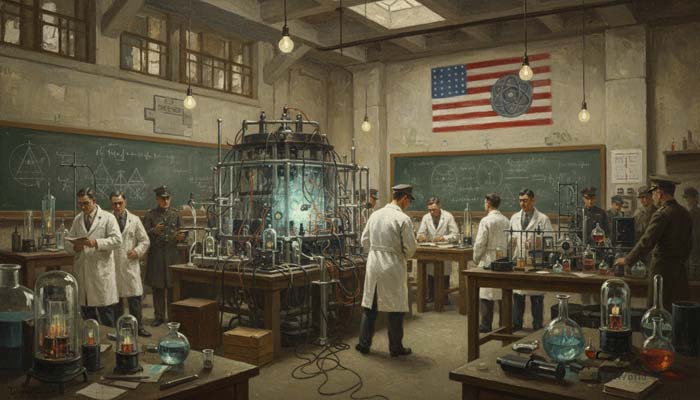
Scientists working in a Manhattan Project laboratory

Science, Physics & National Technology

Scientists whose work in physics, mathematics, nuclear science, astronomy and aerospace changed American research and national technology.

Explore →
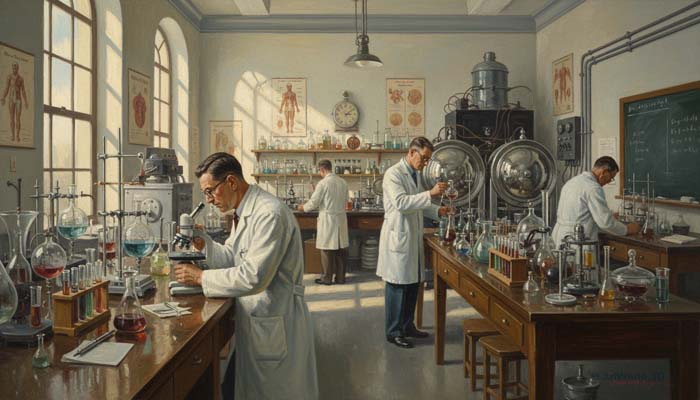
Researchers working in a medical laboratory

Medicine, Biology & Pharmaceuticals

Researchers, physicians and pharmaceutical pioneers whose discoveries prevented disease, extended life and transformed modern medicine.

Explore →
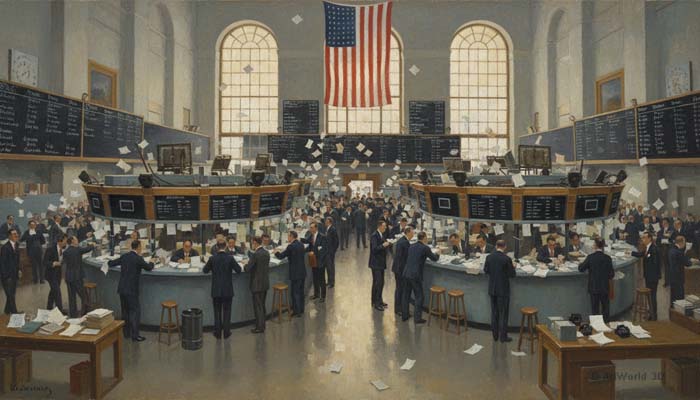
Traders on an early American stock exchange floor

Banking, Finance, Investing & Economics

Financiers, bankers and economists who built institutions, markets and tools that supplied capital to a growing nation.

Explore →
Interior of an early American department store

Retail, Consumer Goods & Entrepreneurship

Entrepreneurs who changed how Americans bought, financed, marketed, wore and consumed everyday products and services.

Explore →
Cast and crew working on an early Hollywood movie set

Film, Television & Hollywood

Studio founders, producers, directors and performers who helped create Hollywood and the language of American film.

Explore →
Musicians performing in an American jazz club

Music, Theater & Popular Culture

Composers, performers and entertainers whose work became part of the American musical and popular-cultural vocabulary.

Explore →
Workers operating machinery in a newspaper press room

Journalism, Publishing & Communications

Publishers, editors and broadcasters who changed American newspapers, magazines, television news and the meaning of a free press.

Explore →
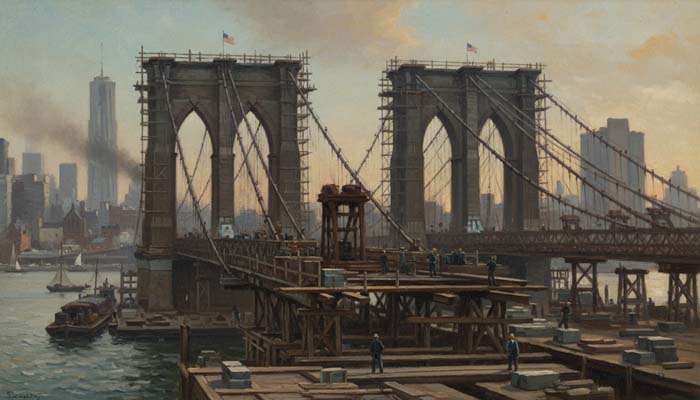
Brooklyn Bridge under construction in New York

Architecture, Engineering, Design & the Built Environment

Architects and engineers whose buildings, bridges and structural systems reshaped the American landscape.

Explore →

Industry, Manufacturing, Transportation & Communications

The builders of American industrial capacity — steel, power, communications, aviation, automobiles and mass-market manufacturing.

A

Andrew Carnegie

1835–1919 · Scotland
Steel & Philanthropy

Arriving in America at 13, Carnegie rose from cotton-mill work to become the dominant force in American steel. Carnegie Steel helped supply the material of industrial expansion; its 1901 sale helped create U.S. Steel. He later gave away most of his fortune, funding thousands of public libraries and major educational and philanthropic institutions.

“The man who dies rich dies disgraced.”
A

Alexander Graham Bell

1847–1922 · Scotland
Communications & Invention

Bell received the fundamental U.S. telephone patent in 1876 and helped turn voice communication over wires into a practical commercial system. The Bell Telephone enterprise grew into the network that ultimately became AT&T, helping transform American business, emergency communication and everyday social life.

“Before anything else, preparation is the key to success.”
N

Nikola Tesla

1856–1943 · Austrian Empire (now Croatia)
Electric Power & Engineering

Tesla’s alternating-current system made long-distance electrical transmission practical and helped establish the power architecture used across the United States. His induction motor and work on the Niagara Falls generating system were central to the spread of electric power into factories, cities and homes.

“The present is theirs; the future, for which I really worked, is mine.”
J

John Jacob Astor

1763–1848 · Germany
Trade & Real Estate

Astor arrived in America in the 1780s and built a vast fortune first through the fur trade and later through Manhattan real estate. His American Fur Company became a dominant commercial force, while his long-term land investments made him one of the wealthiest figures in early American business.

“A man who has a million dollars is as well off as if he were rich.”
S

Samuel Slater

1768–1835 · England
Textiles & Manufacturing

Slater brought detailed knowledge of British textile machinery to the United States and helped establish a successful water-powered cotton-spinning mill in Rhode Island. His work accelerated the mechanization of American textile production and became a landmark in the country’s early Industrial Revolution.

“Whatever you do, do it well and thoroughly, and it will tell in the end.”
D

David Sarnoff

1891–1971 · Russian Empire
Radio, Television & Media

Arriving in New York as a child, Sarnoff rose from telegraph work to lead RCA for decades. He helped build NBC into a national radio network, pushed the commercialization of television and helped shape the structure of American broadcasting and recorded entertainment.

“Nobody can be successful unless he loves his work.”
I

Igor Sikorsky

1889–1972 · Russian Empire
Aviation & Helicopters

After leaving revolutionary Russia, Sikorsky rebuilt his aviation career in the United States. His VS-300 demonstrated the main-rotor and tail-rotor configuration that became standard for helicopters, helping establish rotary-wing aircraft for rescue, transport, military and presidential use.

“The work of the individual still remains the spark that moves mankind forward.”
W

William Boeing

1881–1956 · U.S.-born, German immigrant father
Aviation Manufacturing

Boeing founded an aircraft company in Seattle in 1916 that became one of the central manufacturers of American military and commercial aviation. Its wartime bombers and later jetliners helped make large-scale air travel and aerospace manufacturing major parts of the U.S. economy.

“We are all working together to a common end.”
H

Henry Ford

1863–1947 · U.S.-born, Irish immigrant father and Belgian-American mother
Automobiles & Mass Production

Ford did not invent the automobile, but the Model T and moving assembly line radically lowered its cost and brought car ownership within reach of ordinary Americans. His manufacturing methods influenced industries far beyond automobiles and helped reshape American geography, labor and consumer life.

“Whether you think you can or you think you can’t, you’re right.”
L

Levi Strauss

1829–1902 · Germany
Apparel & Manufacturing

Strauss came to San Francisco during the Gold Rush and, with tailor Jacob Davis, patented riveted work pants in 1873. The durable garment evolved into blue jeans, one of the most recognizable American products and a global symbol that moved from workwear into mainstream culture.

“The greatest pleasure a man can know is to do a good deed in secret and have it found out by accident.”

Technology, Computing & the Internet

Entrepreneurs and engineers who helped define semiconductors, networked computing, the internet, digital marketplaces, mobile technology and artificial intelligence.

S

Sergey Brin

1973– · Soviet Union
Search & Internet

Brin came to the United States as a child and later co-founded Google with Larry Page at Stanford. Their search technology transformed access to online information and helped build a company that became a major force in advertising, mobile computing, cloud services and artificial intelligence.

“You always hear that money doesn’t buy happiness. I’ve always figured a lot of money will buy you a little bit of happiness.”
A

Andrew Grove

1936–2016 · Hungary
Semiconductors & Management

Grove survived Nazi occupation and escaped Communist Hungary before building a career in American technology. As Intel’s chief executive, he helped make microprocessors the company’s defining business and Intel a central supplier to the personal-computer revolution.

“Success breeds complacency. Complacency breeds failure. Only the paranoid survive.”
A

Andy Bechtolsheim

1955– · Germany
Network Computing

Bechtolsheim co-founded Sun Microsystems and helped advance workstation and network-computing architecture. He later became Google’s first outside investor and co-founded Arista Networks, extending his influence across several generations of Silicon Valley infrastructure.

“The first step is you have to say that you can.”
V

Vinod Khosla

1955– · India
Computing & Venture Capital

Khosla co-founded Sun Microsystems and later became one of Silicon Valley’s most prominent venture investors. Through Khosla Ventures, he backed companies across computing, clean energy, biotechnology and health, helping move new technologies from research into commercial markets.

“The only difference between a caprice and a lifelong passion is that the caprice lasts a little longer.”
J

Jerry Yang

1968– · Taiwan
Internet Services

Yang came to California as a child and co-founded Yahoo while at Stanford. Yahoo became one of the web’s first mass-market destinations, combining directories, search, email, news and other services that introduced millions of Americans to everyday internet use.

“In Silicon Valley, we tend to believe that anything you can imagine, you can build.”
J

Jan Koum

1976– · Soviet Ukraine
Mobile Messaging

Koum immigrated to California as a teenager and later co-founded WhatsApp. Its simple, inexpensive mobile-messaging model spread globally and helped make internet-based messaging a basic communications tool before Facebook acquired the company in 2014.

“No ads! No games! No gimmicks!”
P

Pierre Omidyar

1967– · France (Iranian parents)
E-Commerce

Omidyar created the online marketplace that became eBay in 1995. By connecting individual buyers and sellers at massive scale, eBay helped establish consumer-to-consumer e-commerce and gave small businesses access to customers far beyond their local markets.

“I had a vision of using the internet to create a marketplace where normal people could buy and sell things.”
E

Elon Musk

1971– · South Africa
Electric Vehicles, Space & Communications

Musk built major American companies across several difficult industries, including SpaceX, Tesla and Starlink. Their work accelerated reusable launch systems, electric-vehicle adoption and satellite broadband, making him one of the most consequential technology entrepreneurs of the early 21st century.

“When something is important enough, you do it even if the odds are not in your favor.”
J

Jensen Huang

1963– · Taiwan
Semiconductors & Artificial Intelligence

Huang co-founded NVIDIA in 1993 around graphics processors. The company’s GPUs later proved exceptionally useful for parallel computation, becoming foundational hardware for machine learning, scientific computing and the modern artificial-intelligence boom.

“Software is eating the world, but AI is going to eat software.”
S

Steve Jobs

1955–2011 · U.S.-born, biological father a Syrian immigrant
Personal Computing & Consumer Technology

Jobs co-founded Apple and helped lead successive products that changed personal computing, digital music, smartphones and tablets. His emphasis on tightly integrated hardware, software and design helped make consumer technology simpler, more visual and more central to everyday life.

“Your work is going to fill a large part of your life, and the only way to be truly satisfied is to do what you believe is great work.”

Science, Physics & National Technology

Scientists whose work in physics, mathematics, nuclear science, astronomy and aerospace changed American research and national technology.

A

Albert Einstein

1879–1955 · Germany
Theoretical Physics

Einstein settled in the United States after the rise of Nazi Germany. His theories of relativity transformed modern physics, while his 1939 warning to President Franklin Roosevelt about possible German atomic research helped spur U.S. attention to nuclear weapons. He received the 1921 Nobel Prize in Physics for work on the photoelectric effect.

“Imagination is more important than knowledge.”
E

Enrico Fermi

1901–1954 · Italy
Nuclear Physics

Fermi left Fascist Italy and continued his work in the United States. At the University of Chicago in 1942, his team achieved the first controlled, self-sustaining nuclear chain reaction, a decisive step in nuclear science and the Manhattan Project.

“Whatever nature has in store for mankind, unpleasant as it may be, men must accept, for ignorance is never better than knowledge.”
J

John von Neumann

1903–1957 · Hungary
Mathematics & Computing

Von Neumann made major contributions to mathematics, quantum mechanics, game theory, economics and computing. The stored-program computer architecture associated with his name became a basic model for digital computers, while his wartime work also influenced U.S. weapons research.

“If people do not believe that mathematics is simple, it is only because they do not realize how complicated life is.”
E

Edward Teller

1908–2003 · Hungary
Nuclear Physics & National Security

Teller fled Europe and became a major figure in American nuclear research. He worked on the Manhattan Project and later became closely associated with development of the hydrogen bomb, remaining an influential and controversial voice in U.S. defense science for decades.

“No endeavor that is worthwhile is simple in prospect; if it is right, it will be simple in retrospect.”
L

Leo Szilard

1898–1964 · Hungary
Nuclear Physics & Policy

Szilard conceived the possibility of a nuclear chain reaction and later worked with Enrico Fermi on reactor concepts. He drafted the 1939 letter signed by Einstein that warned Roosevelt about atomic weapons, then became an outspoken advocate for control of nuclear arms.

“A scientist’s aim in a discussion with his colleagues is not to persuade, but to clarify.”
H

Hans Bethe

1906–2005 · Germany
Nuclear & Stellar Physics

Bethe came to the United States after losing his German academic position under Nazi rule. He led the theoretical division at Los Alamos during the Manhattan Project and later won the 1967 Nobel Prize in Physics for explaining the nuclear processes that power stars.

“I have done my share.”
S

Subrahmanyan Chandrasekhar

1910–1995 · India
Astrophysics

Chandrasekhar developed the mass limit that determines whether a dying star can remain a white dwarf or must collapse further. His work became fundamental to modern stellar astrophysics and earned him a share of the 1983 Nobel Prize in Physics.

“The pursuit of science has often been compared to the scaling of mountains, high and not so high.”
C

Chien-Shiung Wu

1912–1997 · China
Experimental Physics

Wu came to the United States for graduate study and became one of the leading experimental physicists of her era. Her famous parity experiment demonstrated that a long-assumed symmetry law did not hold in weak nuclear interactions, reshaping particle physics.

“I wonder whether the fact that I have always been pushing and setting goals for myself has anything to do with the fact that I am the first daughter of an immigrant family that had to fight to survive.”
G

George Gamow

1904–1968 · Russian Empire
Cosmology & Nuclear Physics

After leaving the Soviet Union, Gamow worked in the United States on nuclear physics and cosmology. He helped develop Big Bang nucleosynthesis theory and also became an influential popularizer of science through books that made difficult physics accessible to general readers.

“If you are not somewhat confused by quantum mechanics, you have not understood it.”
W

Wernher von Braun

1912–1977 · Germany
Rocketry & Spaceflight

Brought to the United States after World War II, von Braun became a leading figure in the American rocket program and later NASA’s Saturn V effort, which enabled the Apollo moon landings. His earlier work for Nazi Germany and the V-2 program remains inseparable from assessment of his legacy.

“Research is what I’m doing when I don’t know what I’m doing.”

Medicine, Biology & Pharmaceuticals

Researchers, physicians and pharmaceutical pioneers whose discoveries prevented disease, extended life and transformed modern medicine.

J

Jonas Salk

1914–1995 · U.S.-born, Russian-Jewish immigrant parents
Vaccines & Virology

Salk developed the inactivated polio vaccine announced in 1955, helping turn a feared childhood disease into a preventable one. He declined to patent the vaccine and later founded the Salk Institute for Biological Studies in California.

“The reward for work well done is the opportunity to do more.”
A

Albert Sabin

1906–1993 · Russian Empire (now Poland)
Vaccines & Virology

Sabin came to the United States as a young immigrant and developed the oral polio vaccine. Its ease of administration made it especially useful for mass immunization and global eradication campaigns.

“I have never had the temptation to work for profit.”
S

Selman Waksman

1888–1973 · Russian Empire (now Ukraine)
Antibiotics & Microbiology

Waksman studied soil microorganisms at Rutgers and led research that produced streptomycin, the first effective antibiotic treatment for tuberculosis. He received the 1952 Nobel Prize in Physiology or Medicine and helped establish soil microbiology as a major source of therapeutic drugs.

“Wherever we look upon this earth, the opportunities take shape within the problems.”
K

Katalin Karikó

1955– · Hungary
mRNA & Biotechnology

Karikó persisted for decades in research on messenger RNA despite repeated professional setbacks. Her work on modified mRNA helped make the platform practical for vaccines, including the COVID-19 vaccines, and earned her a share of the 2023 Nobel Prize in Physiology or Medicine.

“There is always a way. You just have to keep going.”
A

Albert Claude

1899–1983 · Belgium
Cell Biology

Claude developed techniques for separating and studying the internal components of cells, helping create modern cell biology. His work at Rockefeller laid foundations for understanding cell structure and earned him a share of the 1974 Nobel Prize in Physiology or Medicine.

“It is the destiny of the scientist to be an eternal student.”
R

Renato Dulbecco

1914–2012 · Italy
Cancer Biology & Genomics

Dulbecco’s research showed how tumor viruses can alter host-cell genetic material, advancing understanding of cancer at the molecular level. He shared the 1975 Nobel Prize in Physiology or Medicine and later became an early advocate for sequencing the human genome.

“The secret of science is that it has to be done.”
B

Baruch Blumberg

1925–2011 · U.S.-born, immigrant Jewish parents
Hepatitis & Vaccines

Blumberg discovered the hepatitis B surface antigen, a breakthrough that enabled blood screening and helped lead to a vaccine against hepatitis B. Because chronic hepatitis B can cause liver cancer, the vaccine also became an important cancer-prevention tool.

“Scientific research is one of the most exciting and rewarding of occupations.”
D

David Ho

1952– · Taiwan
HIV/AIDS Research

Ho came to California as a child and became a leading HIV/AIDS researcher. His work helped establish combination antiretroviral therapy, transforming HIV infection for many patients from a rapidly fatal disease into a manageable chronic condition.

“The beauty of science is that it’s self-correcting.”
G

George Papanicolaou

1883–1962 · Greece
Cancer Screening

Papanicolaou developed the cervical cytology test now known as the Pap smear. Widespread screening allowed cervical abnormalities and cancers to be detected earlier, dramatically improving prevention and treatment outcomes.

“I have devoted my whole life to medical science.”
C

Charles Pfizer

1824–1906 · Germany
Pharmaceutical Manufacturing

Pfizer came to New York in 1848 and co-founded a chemical and pharmaceutical business with his cousin. The company grew from specialty medicines into the enterprise that became Pfizer, one of the world’s major pharmaceutical manufacturers.

“The secret of success is to do common work uncommonly well.”

Banking, Finance, Investing & Economics

Financiers, bankers and economists who built institutions, markets and tools that supplied capital to a growing nation.

A

Alexander Hamilton

1755–1804 · Nevis, British West Indies
Public Finance & Economic Policy

Hamilton arrived in the mainland colonies from the Caribbean and became the first U.S. Treasury secretary. He designed key elements of the federal financial system, including public credit, debt assumption, customs administration and the first Bank of the United States.

“Those who stand for nothing fall for anything.”
J

Joseph Seligman

1819–1880 · Germany
Investment Banking & Railroads

Seligman built J. & W. Seligman & Company into an important 19th-century investment bank. During the Civil War the firm helped market Union bonds in Europe and later supplied capital for American railroad and industrial expansion.

“I have always found that to be honest is the best policy.”
M

Marcus Goldman

1821–1904 · Germany
Investment Banking

Goldman immigrated to the United States and founded Marcus Goldman & Co. in New York in 1869. The firm specialized in commercial paper and, after Samuel Sachs joined, evolved into Goldman Sachs, one of the country’s most enduring investment banks.

“The worth of a man must be measured by his life, not by his death.”
J

Jacob Schiff

1847–1920 · Germany
Banking & Railroad Finance

Schiff became head of Kuhn, Loeb & Company and helped finance major American railroad systems and industrial development. He was also a prominent philanthropist and used his financial influence in international affairs, particularly in opposition to persecution of Jews in Imperial Russia.

“An honorable man is one who is truly honest.”
J

Jules Bache

1861–1944 · Germany
Retail Brokerage & Investing

Bache built J.S. Bache & Co. into a major brokerage business with offices across the United States. He helped widen access to securities investing and also became a significant art collector whose holdings entered the Metropolitan Museum of Art.

“The wise investor knows that the road to wealth is paved with patience.”
F

Felix Warburg

1871–1937 · Germany
Banking & Philanthropy

Warburg became a senior partner at Kuhn, Loeb and a major figure in American philanthropy. He supported Jewish social-service organizations, cultural institutions and relief efforts; his former Manhattan home later became the Jewish Museum.

“The human spirit is almost indestructible.”
T

Thomas Peterffy

1944– · Hungary
Electronic Trading

Peterffy left Communist Hungary and built a career in the United States as a programmer and trader. He became a pioneer in using computers to automate securities trading and later built Interactive Brokers into a major electronic brokerage platform.

“Freedom is not a birthright. It has to be defended, cherished, and nurtured.”
G

George Soros

1930– · Hungary
Investment Management & Philanthropy

Soros survived Nazi-occupied Hungary, left Communist rule and later built one of the most successful investment careers of the late 20th century. He also committed much of his fortune to philanthropy through the Open Society Foundations.

“It’s not whether you’re right or wrong that’s important, but how much money you make when you’re right and how much you lose when you’re wrong.”
M

Michael Milken

1946– · U.S.-born, immigrant-descended family
High-Yield Finance

Milken helped make high-yield bonds a major source of corporate financing, expanding access to capital for companies below investment grade. His Wall Street career ended after a securities conviction; he was later pardoned and became a large-scale philanthropist in medical research and education.

“I learned more about business from my first job than from my MBA.”
M

Myron Scholes

1941– · Canada
Financial Economics

Scholes, working with Fischer Black and Robert Merton, helped develop the modern mathematical framework for pricing options. The Black-Scholes model became foundational to derivatives markets and quantitative finance; Scholes shared the 1997 Nobel memorial prize in economics.

“The goal of financial theory is to understand the structure of equilibrium prices.”

Retail, Consumer Goods & Entrepreneurship

Entrepreneurs who changed how Americans bought, financed, marketed, wore and consumed everyday products and services.

I

Isaac Singer

1811–1875 · U.S.-born, German immigrant parents
Consumer Manufacturing & Sales

Singer improved and commercialized the sewing machine through manufacturing, installment payments, advertising and a broad dealer network. The Singer company became an early model of global consumer-product marketing and brought mechanized sewing into ordinary households.

“If I had thought about it, I wouldn’t have done the experiment.”
E

Estée Lauder

1908–2004 · U.S.-born, Hungarian and Czech Jewish immigrant parents
Cosmetics & Brand Building

Lauder turned small-scale beauty sales into a global cosmetics company through personal selling, department-store distribution, prestige branding and free samples. Her approach helped define modern beauty marketing and made Estée Lauder one of the industry’s most durable American brands.

“I have never worked a day in my life without selling. If I believe in something, I sell it, and I sell it hard.”
M

Max Factor

1877–1938 · Russian Empire (now Poland)
Cosmetics & Film Makeup

Factor came to Los Angeles and developed cosmetics suited to motion-picture photography. His innovations moved from film studios into consumer retail, helping popularize modern makeup and linking Hollywood glamour with mass-market beauty products.

“Makeup is the greatest invention since clothing.”
H

Helena Rubinstein

1872–1965 · Poland
Beauty & Luxury Retail

Rubinstein built an international skin-care and cosmetics empire before making New York a central base. She combined luxury branding, scientific claims and aggressive retail expansion to help create the modern premium beauty business.

“There are no ugly women, only lazy ones.”
L

Liz Claiborne

1929–2007 · Belgium (American parents)
Fashion & Working-Women’s Apparel

Claiborne co-founded Liz Claiborne Inc. to make stylish, practical clothing for the rapidly growing population of women working in offices. The company’s success helped redefine American ready-to-wear and became the first company founded by a woman to enter the Fortune 500.

“I created Liz Claiborne for women like myself: real women with real lives.”
A

Amadeo Giannini

1870–1949 · U.S.-born, Italian immigrant parents
Consumer Banking

Giannini founded the Bank of Italy in San Francisco to serve immigrants, workers, farmers and small businesses often overlooked by established banks. His expansion of branch banking and consumer finance helped build the institution that became Bank of America.

“I am no longer working for money. I want to see what I can do for the people.”
I

Isidor Straus

1845–1912 · Germany
Department Stores

Straus came to America as a child and, with his brother Nathan, eventually took control of Macy’s. Their management helped turn the department store into one of the largest and most influential retail institutions in the country.

“We have lived together for so many years. Where you go, I go.”
N

Nathan Straus

1848–1931 · Germany
Retail & Public Health Philanthropy

Straus helped build Macy’s with his brother Isidor but became especially known for public-health philanthropy. He financed pasteurized-milk depots and campaigned for safer milk supplies at a time when contaminated milk was a major cause of childhood illness and death.

“What you give to the poor, you lend to God.”
A

Andrew Cherng

1948– · China
Restaurants & Franchising

Cherng came to the United States and, with family members, developed Panda Inn and then Panda Express. The fast-casual chain grew into the largest Chinese-American restaurant brand in the country, bringing an adapted Chinese menu to mainstream American shopping centers and communities.

“Every day, work harder on yourself than you do on your business.”
H

Hamdi Ulukaya

1972– · Turkey
Food Manufacturing & Entrepreneurship

Ulukaya bought a closed yogurt plant in upstate New York and built Chobani into a leading American food brand. Its growth helped popularize Greek yogurt nationally while creating manufacturing jobs and drawing attention to refugee employment and community investment.

“Business can be good and do good at the same time.”

Film, Television & Hollywood

Studio founders, producers, directors and performers who helped create Hollywood and the language of American film.

L

Louis B. Mayer

1884–1957 · Russian Empire
Studio Leadership & Production

Mayer rose from theater ownership to co-found Metro-Goldwyn-Mayer in 1924. Under his leadership MGM became one of Hollywood’s most prestigious studios, known for a large contract-star roster and a highly organized version of the studio system.

“If you work with the best, you will produce the best.”
S

Samuel Goldwyn

1879–1974 · Russian Empire (now Poland)
Independent Film Production

Goldwyn came to the United States as a young immigrant and became one of Hollywood’s most important independent producers. His companies and productions helped establish feature filmmaking as a prestige business, culminating in films such as The Best Years of Our Lives.

“A wide screen just makes a bad film twice as bad.”
A

Adolph Zukor

1873–1976 · Hungary
Studio System & Feature Films

Zukor arrived in New York as a teenager and became a pioneer of feature-length motion pictures. He built Famous Players into the enterprise that evolved into Paramount Pictures and helped establish the vertically organized Hollywood studio system.

“If you have a good story and a good director, you have a good picture.”
W

William Fox

1879–1952 · Hungary
Studios & Sound Film

Fox grew up on New York’s Lower East Side and built the Fox Film Corporation. His company became an important early adopter of sound-news and sound-film technology, and its legacy continued through the studio that became 20th Century Fox.

“The talking picture will take the place of a great deal of the other industries.”
C

Carl Laemmle

1867–1939 · Germany
Studio Founding & Star System

Laemmle immigrated to the Midwest and later founded Universal Pictures. He fought the Edison-controlled patent system, helped strengthen independent film production and promoted performers by name, contributing to the rise of the Hollywood star system.

“Look at the man who is successful. The chances are a hundred to one he is earnest.”
H

Harry Warner

1881–1958 · Russian Empire (now Poland)
Studio Leadership & Sound Film

Harry Warner, eldest of the Warner brothers, served as president of Warner Bros. and backed the company’s risky investment in synchronized sound. The success of The Jazz Singer in 1927 helped accelerate the industry-wide transition from silent pictures to talkies.

“I’m not interested in being understood. I’m interested in being successful.”
J

Jack Warner

1892–1978 · Canada (Polish-Jewish immigrant parents)
Studio Production

Jack Warner ran Hollywood production for Warner Bros. across much of the studio era. His tenure encompassed films from Casablanca and Yankee Doodle Dandy to My Fair Lady and Bonnie and Clyde, giving the studio an unusually long run of cultural influence.

“I’ve never met a man I didn’t like, unless you count studio executives.”
B

Billy Wilder

1906–2002 · Austrian Empire (now Poland)
Writing & Directing

Wilder fled Europe after the rise of Hitler and became one of Hollywood’s great writer-directors. His work ranged across film noir, comedy, drama and satire, including Double Indemnity, Sunset Boulevard, Some Like It Hot and The Apartment.

“Trust your own instinct. Your mistakes might as well be your own, instead of someone else’s.”
F

Frank Capra

1897–1991 · Italy
Film Direction

Capra came to the United States from Sicily as a child and directed some of the most enduring films about ordinary Americans, civic ideals and democratic life. His work includes It Happened One Night, Mr. Smith Goes to Washington and It’s a Wonderful Life.

“There are no rules in filmmaking. Only sins. And the cardinal sin is dullness.”
C

Charlie Chaplin

1889–1977 · England
Performance, Direction & Production

Chaplin came to America with a touring music-hall company and created the Tramp, one of cinema’s most recognizable characters. As performer, writer, director and co-founder of United Artists, he helped establish film comedy and greater creative control for filmmakers.

“A day without laughter is a day wasted.”

Music, Theater & Popular Culture

Composers, performers and entertainers whose work became part of the American musical and popular-cultural vocabulary.

I

Irving Berlin

1888–1989 · Russian Empire
Songwriting & Broadway

Berlin came to New York as a child and became one of the most prolific songwriters in American history. His catalog included God Bless America, White Christmas, Easter Parade and scores of Broadway and popular songs that became part of the national repertoire.

“Life is 10 percent what you make it and 90 percent how you take it.”
G

George Gershwin

1898–1937 · U.S.-born, Russian-Jewish immigrant parents
Composition & American Popular Music

Gershwin combined jazz, popular song and concert music in works such as Rhapsody in Blue, An American in Paris and Porgy and Bess. His short career helped define a distinctly American sound that crossed the boundary between popular and classical music.

“Life is a lot like jazz. It’s best when you improvise.”
I

Ira Gershwin

1896–1983 · U.S.-born, Russian-Jewish immigrant parents
Lyrics & Musical Theater

Ira Gershwin wrote lyrics for many of George Gershwin’s best-known songs and later collaborated with other major composers. His witty, conversational language helped set a standard for American popular-song lyrics and musical theater.

“A lyric is an emotional shorthand — and the song does what the words can’t do alone.”
A

Al Jolson

1886–1950 · Russian Empire (now Lithuania)
Vaudeville, Broadway & Film

Jolson became one of the dominant American entertainers of the early 20th century through vaudeville, Broadway, recordings and film. His starring role in The Jazz Singer made him central to the commercial breakthrough of synchronized sound in feature movies.

“You ain’t heard nothin’ yet!”
S

Sergei Rachmaninoff

1873–1943 · Russian Empire
Piano & Composition

Rachmaninoff settled in the United States after the Russian Revolution and built a major concert career as a pianist. His recordings and compositions became enduring parts of American and international concert life.

“Music is enough for a lifetime, but a lifetime is not enough for music.”
D

Dimitri Tiomkin

1894–1979 · Russian Empire (now Ukraine)
Film Composition

Tiomkin came to the United States in the 1920s and became one of classic Hollywood’s most prominent film composers. His scores for High Noon, Giant, The Alamo and many Westerns helped define the musical language of American screen epics.

“Music in films must be an emotional shorthand for what the director cannot say.”
M

Max Steiner

1888–1971 · Austria-Hungary
Film Scoring

Steiner became a pioneering Hollywood composer whose work helped establish the continuous orchestral film score. King Kong and later scores including Gone with the Wind and Now, Voyager influenced generations of screen composers.

“The music tells the story when the words cannot.”
E

Erich Wolfgang Korngold

1897–1957 · Austria-Hungary
Film & Concert Composition

Korngold came to Hollywood after an acclaimed European career and helped create the lush symphonic style associated with adventure films. His score for The Adventures of Robin Hood won an Academy Award and became an enduring model for later film music.

“I have always written what I felt, and I shall always do so.”
B

Bob Hope

1903–2003 · England
Comedy & Popular Entertainment

Hope came to Cleveland as a child and built a career spanning vaudeville, Broadway, radio, movies and television. His decades of performances for American military personnel overseas made him one of the country’s most familiar entertainers.

“A bank is a place that will lend you money if you can prove that you don’t need it.”
M

Mikhail Baryshnikov

1948– · Soviet Union (now Latvia)
Dance & Performance

Baryshnikov defected from the Soviet Union in 1974 and became a leading figure at American Ballet Theatre. His work across classical ballet, modern dance and acting expanded the possibilities for male dancers in American performance culture.

“No matter what country you are in, art is a universal language.”

Journalism, Publishing & Communications

Publishers, editors and broadcasters who changed American newspapers, magazines, television news and the meaning of a free press.

J

Joseph Pulitzer

1847–1911 · Hungary
Newspapers & Investigative Journalism

Pulitzer came to the United States during the Civil War and built the New York World into a mass-circulation newspaper known for aggressive reporting and visual presentation. His estate endowed the Pulitzer Prizes, which became among the most prestigious honors in American journalism and letters.

“Newspapers are the university of the poor.”
H

Henry Luce

1898–1967 · China (American missionary parents)
Magazine Publishing

Luce co-founded Time and later built Fortune, Life and Sports Illustrated. His magazines reached enormous national audiences and helped shape the visual and editorial language through which 20th-century Americans encountered news, business, culture and sport.

“I became a journalist to come as close as possible to the heart of the world.”
A

Arianna Huffington

1950– · Greece
Digital Publishing

Huffington co-founded The Huffington Post in 2005, helping establish aggregation, blogging and social-media distribution as major components of online news. The site’s commercial success made it an important model for digital publishing in the early social-web era.

“Fearlessness is not the absence of fear. It’s the mastery of fear.”
T

Tina Brown

1953– · England
Magazine Editing & Digital Media

Brown came to New York to edit Vanity Fair and later led The New Yorker, reshaping the visual style, celebrity coverage and pacing of both magazines. She later founded The Daily Beast and became a major figure in American magazine and digital-media culture.

“The key to great editing is knowing what to leave in and what to take out.”
R

Rupert Murdoch

1931– · Australia
News & Media Ownership

Murdoch expanded into the United States in the 1970s, became a citizen in 1985 and built a major newspaper, television and cable-news empire. His companies, especially Fox News, have had a large and continuing influence on American media and political communication.

“In motivating people, you’ve got to engage their minds and their hearts.”
T

Ted Koppel

1940– · England (German-Jewish refugee parents)
Broadcast Journalism

Koppel came to America as a child and built a long career at ABC News. As anchor of Nightline from 1980 to 2005, he brought a serious interview-driven format to late-night television news and became one of the era’s best-known broadcast journalists.

“The responsibility of the press is to comfort the afflicted and to afflict the comfortable.”
M

Mike Wallace

1918–2012 · U.S.-born, Russian-Jewish immigrant parents
Investigative Television

Wallace became a defining correspondent of 60 Minutes and helped popularize the confrontational television interview. His preparation, direct questioning and willingness to challenge powerful subjects became a model for American broadcast investigative journalism.

“I’ve always been a reporter. It’s been my life.”
W

Walter Winchell

1897–1972 · U.S.-born, Russian-Jewish immigrant parents
Syndication & Radio Commentary

Winchell built a huge audience through syndicated newspaper columns and radio broadcasts that blended celebrity gossip, crime reporting and political commentary. His style helped create the modern culture of celebrity-driven news and mass-media personality journalism.

“A real friend is one who walks in when the rest of the world walks out.”
A

Arthur Ochs Sulzberger

1926–2012 · U.S.-born, German-Jewish immigrant newspaper family
Newspaper Publishing

Sulzberger led The New York Times through a period of national expansion and major press-freedom battles. Under his leadership the paper published the Pentagon Papers despite government opposition, a landmark confrontation over the First Amendment.

“The duty of a newspaper is to comfort the afflicted and afflict the comfortable.”
J

John Peter Zenger

1697–1746 · Germany
Printing & Press Freedom

Zenger came to colonial New York as an indentured servant and became a printer and publisher. His 1735 acquittal on seditious-libel charges after printing criticism of the royal governor became an enduring symbol in the development of American press freedom.

“The question before the court is not the cause of a poor printer — it is the cause of every free man that lives under a British government.”

Architecture, Engineering, Design & the Built Environment

Architects and engineers whose buildings, bridges and structural systems reshaped the American landscape.

I

I. M. Pei

1917–2019 · China
Architecture & Cultural Institutions

Pei came to the United States to study architecture and built a seven-decade career that included the National Gallery of Art East Building, the Louvre Pyramid and the Rock and Roll Hall of Fame. He became one of the most internationally recognized architects working from America.

“Architecture is the art of how to waste space.”
L

Ludwig Mies van der Rohe

1886–1969 · Germany
Modernist Architecture

Mies came to the United States in the late 1930s and led architecture at the Illinois Institute of Technology. His glass-and-steel buildings and minimalist design language became central to postwar American modernism and the corporate skyscraper.

“Less is more.”
W

Walter Gropius

1883–1969 · Germany
Architecture & Design Education

Founder of the Bauhaus, Gropius left Germany under Nazi rule and joined Harvard’s architecture faculty. His teaching and design ideas strongly influenced American modern architecture, planning and design education through generations of students and colleagues.

“Only together can we achieve what we cannot do alone.”
E

Eero Saarinen

1910–1961 · Finland
Architecture & Monumental Design

Saarinen came to America as a teenager and became one of the leading architects of the postwar era. His Gateway Arch, TWA Flight Center and other projects brought sculptural form and expressive engineering into major American public architecture.

“Always design a thing by considering it in its next larger context.”
E

Eliel Saarinen

1873–1950 · Finland
Architecture & Design Education

Already a leading Finnish architect, Saarinen settled in the United States in the 1920s and became closely associated with the Cranbrook educational community in Michigan. His teaching helped shape a generation of American architects and designers, including his son Eero.

“Always design a thing by considering it in its next larger context — a chair in a room, a room in a house, a house in an environment.”
R

Rudolf Schindler

1887–1953 · Austria
California Modernism

Schindler came to the United States in 1914, worked with Frank Lloyd Wright and settled in Los Angeles. His experimental houses used open plans, concrete and indoor-outdoor space in ways that anticipated the informal California modern style.

“Space is the medium of architecture.”
R

Richard Neutra

1892–1970 · Austria
Modern Residential Architecture

Neutra moved to Los Angeles and became one of the most internationally recognized architects of California modernism. Houses such as the Lovell Health House and Kaufmann Desert House used glass, landscape and precise modernist detailing to redefine American residential design.

“The house must be built so that people can live in it happily, healthily, and comfortably.”
F

Fazlur Rahman Khan

1929–1982 · British India (now Bangladesh)
Structural Engineering & Skyscrapers

Khan came to the United States on a Fulbright scholarship and joined Skidmore, Owings & Merrill. His tubular structural systems made extremely tall buildings more efficient and practical, influencing skyscraper engineering worldwide and enabling projects such as the Sears Tower.

“The technical man must not be lost in his own technology.”
J

John Roebling

1806–1869 · Germany
Bridge Engineering

Roebling came to Pennsylvania in the 1830s and became a pioneer of wire-cable suspension bridges. His engineering work culminated in the design of the Brooklyn Bridge, completed after his death under the direction of his son Washington Roebling.

“The superior man is he who develops, in harmonious proportions, his moral, intellectual, and physical nature.”
O

Othmar Ammann

1879–1965 · Switzerland
Bridge Engineering

Ammann came to New York in 1904 and became one of the defining bridge engineers of the 20th century. His designs included the George Washington, Bayonne and Verrazzano-Narrows bridges, giving him an extraordinary physical imprint on the New York region.

“The great bridges of New York are monuments to the courage and engineering genius of those who built them.”
Go deeper

References & Further Reading

American Shapers is intentionally concise. These major archives, museums and biographies offer reliable starting points for readers who want more detail.